NERIS vs NFIRS: Why Fire Incident Reporting Is Evolving
oviedo, United States – March 19, 2026 / EPR Fireworks /
The 40-year-old National Fire Incident Reporting System (NFIRS) has been replaced by NERIS, a cloud-based platform that went live January 1, 2026.
-
NERIS enables near real-time data submission and analytics, eliminating the year-long reporting delays common with NFIRS
-
The new system supports up to three incident types per report, capturing the complexity of modern emergency responses more accurately
-
Cloud-based architecture and API integrations allow seamless data exchange between dispatch, RMS, and federal databases
-
Fire departments should verify their RMS vendor’s NERIS V1 Compatible certification immediately to avoid compliance gaps
Departments still using legacy reporting systems face immediate compliance requirements that demand urgent action.
Fire departments across the United States are navigating their most significant data management transformation in four decades. The transition from NFIRS to NERIS represents a fundamental shift in how emergency services collect, analyze, and share incident information. According to the U.S. Fire Administration, over 33.3 million incident responses were reported through NFIRS in 2024, but the legacy system’s limitations made modernization essential as technology and operational demands evolved.
Understanding the differences between NERIS vs NFIRS helps fire service leaders recognize why this change was necessary and what it means for their operations going forward. The comparison reveals gaps that hampered fire department data management for decades and shows how modern incident reporting can transform daily operations.

What Are the Key Differences Between NERIS vs NFIRS?
The contrast between these two systems extends far beyond a simple software update. NFIRS was designed in the 1970s following the Federal Fire Prevention and Control Act of 1974, built for an era of paper-based reporting and batch data processing. NERIS represents a ground-up reimagining of how emergency response data should flow through the modern fire service ecosystem.
Data Submission and Timing
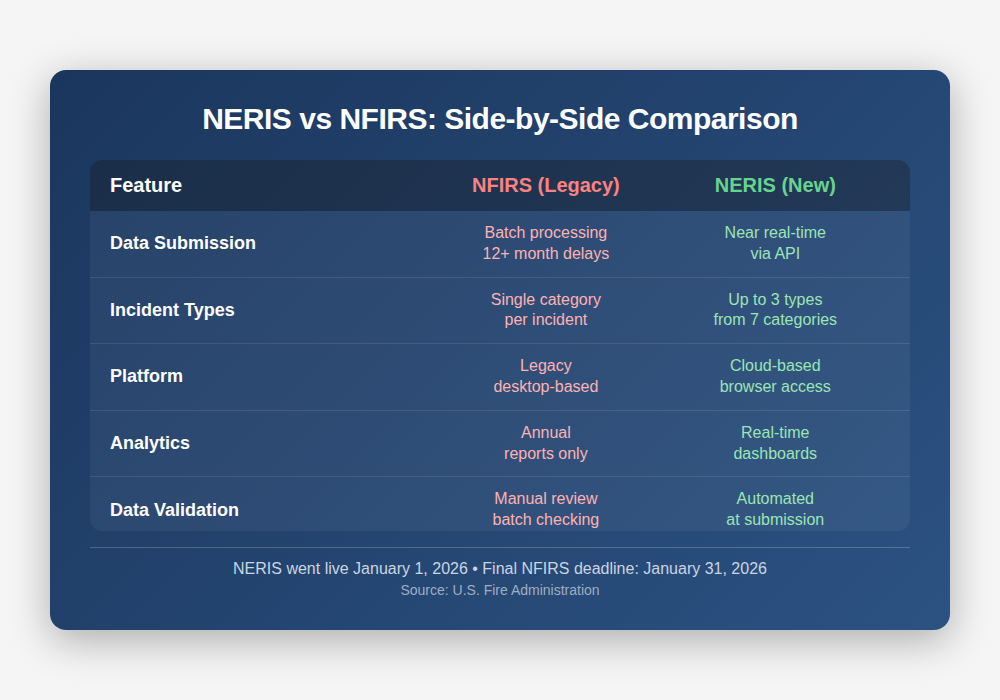
NFIRS operated on a delayed reporting model where departments submitted incident data to their state agencies, which then compiled and forwarded information to the federal database. This process often created reporting delays exceeding 12 months, making the data useful primarily for historical analysis rather than operational decision-making.
NERIS introduces near real-time data submission through API-based connections. Incident information flows automatically from compliant records management systems to federal databases, enabling departments to access analytics and insights within days rather than years. This shift transforms data from a retrospective tool into an active operational resource that supports staffing decisions, resource allocation, and community risk assessment.
Incident Classification Structure
One of the most practical improvements in NERIS involves how incidents are categorized. NFIRS required departments to select a single incident type, even when responses involved multiple emergency categories. A call involving a vehicle fire with patient transport and hazmat considerations got squeezed into one classification, losing valuable information about resource deployment and crew activities.
NERIS allows up to three incident types per report across seven incident categories. This multi-classification approach captures the complexity of real-world responses and provides more accurate data for resource planning, budget justification, and community risk assessment. For departments running unified fire and EMS operations, this flexibility proves especially valuable.
|
Feature |
NFIRS |
NERIS |
|
Data Submission |
Batch processing, often delayed 12+ months |
Near real-time via API integration |
|
Incident Types |
Single category per incident |
Up to three types from seven categories |
|
Platform Architecture |
Legacy desktop-based system |
Cloud-based, browser-accessible |
|
Analytics Access |
Annual reports only |
Real-time dashboards and insights |
|
Data Validation |
Manual review, batch error checking |
Automated validation at submission |
Why Was NFIRS Replaced by NERIS?
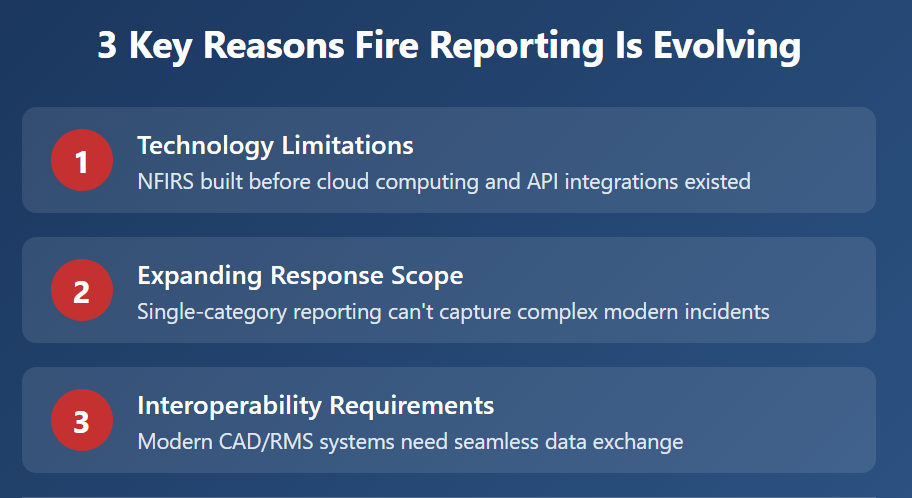
The decision to replace NFIRS wasn’t made lightly. The system served as the backbone of national fire incident data for decades, but its fundamental architecture prevented the integration and real-time capabilities that modern emergency services require.
Technology Limitations
NFIRS was built before cloud computing, mobile devices, and API integrations existed. Updating the platform to accommodate these technologies would have required essentially rebuilding the entire system. The Fire Safety Research Institute, working with the Department of Homeland Security and U.S. Fire Administration, determined that a purpose-built replacement would better serve the fire service than attempting to modernize a 50-year-old foundation.
The USFA reports that NFIRS captured approximately 70% of all fire incidents annually through voluntary participation. NERIS aims to improve both participation rates and data quality through streamlined workflows and immediate feedback on submission errors.
Expanding Emergency Response Scope
Fire departments today handle far more than structure fires. EMS calls represent the majority of responses for most departments, and the scope of hazards continues expanding with lithium-ion battery incidents, wildland-urban interface fires, and technical rescue operations. NFIRS’s rigid structure struggled to capture this operational diversity accurately.
Departments operating integrated fire and EMS services particularly benefit from platforms that unify incident reporting across both disciplines, eliminating data silos and providing comprehensive operational insights.
Interoperability Requirements
Modern emergency response depends on seamless data exchange between Computer-Aided Dispatch systems, records management platforms, regional data sharing networks, and federal repositories. NFIRS lacked the standardized interfaces needed for this integration, creating data silos and requiring duplicate entry across multiple systems. Browser-based, cloud-native platforms eliminate these barriers.
How Did the NFIRS to NERIS Transition Unfold?
The National Volunteer Fire Council emphasized throughout 2024 and 2025 that NERIS implementation was proceeding on an aggressive schedule. That timeline has now reached its conclusion, with NERIS operating as the exclusive federal reporting system since January 1, 2026.
Regional Rollout Completion
NERIS launched in November 2024 with initial departments onboarded during Phase 1. Throughout 2025, thousands of departments transitioned through a regional rollout coordinated by FEMA regions and state fire marshals. Texas departments began their transitions in July 2025, with New England states completing implementation in October 2025.
What This Means Now
The transition period has officially ended. The January 31, 2026 deadline for final NFIRS submissions has passed, and the legacy system is no longer accepting new incident data. Departments that completed their transition are now operating fully within NERIS, benefiting from real-time analytics and streamlined workflows.
For any department that missed the transition window, immediate action is critical. Options include using the free NERIS direct entry application or working with a NERIS V1 Compatible RMS provider to establish compliant reporting capabilities as quickly as possible. Gaps in federal reporting can affect grant eligibility and compliance standing.
What Should Fire Departments Do Now?
For departments already operating in NERIS, the focus shifts to optimization and training reinforcement. Those that experienced delays or gaps during the transition need to address compliance immediately.
Vendor Verification
If your department is still experiencing reporting issues, confirm that your records management system holds NERIS V1 Compatible certification. This certification indicates that the software meets technical standards for data exchange with federal systems. Departments using non-certified platforms face manual workarounds or gaps in federal reporting capability that can affect grant eligibility.
Look for vendors offering unified platforms that handle both fire and EMS incident reporting within a single system. This integration reduces duplicate entry and ensures consistent data quality across all operational areas.
Data Migration Considerations
Historical NFIRS data has been archived and made publicly available through OpenFEMA, but it doesn’t automatically transfer to NERIS. Departments should work with their RMS providers on data access strategies to ensure continuity of historical records for trend analysis and compliance auditing.
Personnel Training
NERIS introduces new workflows, data fields, and validation requirements. Field personnel completing incident reports need ongoing familiarity with the updated interface and classification structure. Administrative staff managing data quality and compliance require training on the new analytics tools and error resolution processes. Platforms offering integrated learning management capabilities can streamline this ongoing education requirement.
Priority Actions
Departments should focus on these areas:
-
Verify RMS vendor NERIS V1 Compatible certification status
-
Complete any pending user account setup and permission assignments
-
Ensure all personnel have received NERIS workflow training
-
Review validation feedback on recent submissions and address recurring errors
-
Establish processes for monitoring data quality metrics
What Benefits Does NERIS Offer Fire Departments?
Beyond compliance requirements, NERIS provides tangible operational advantages that justify the transition effort.
Actionable Intelligence
For the first time, departments receive meaningful analytics from their own incident data without waiting for annual federal reports. Real-time dashboards can highlight response time trends, resource utilization patterns, and community risk indicators. This intelligence supports staffing decisions, equipment purchases, and strategic planning with current information rather than outdated statistics.
Departments using platforms with robust business intelligence modules can leverage NERIS data alongside other operational metrics for comprehensive performance analysis.
Reduced Administrative Burden
API-based submission eliminates manual data export and import processes that consumed administrative time under NFIRS. Real-time validation flags errors immediately, preventing the frustration of batch rejection weeks after submission. The streamlined workflow returns hours to personnel who can focus on operations rather than paperwork.
Enhanced Grant Justification
Accurate, timely data strengthens grant applications by demonstrating current operational needs with supporting evidence. Funding agencies increasingly expect departments to show data-driven approaches to resource allocation, and NERIS provides the foundation for this documentation.
|
NERIS Benefit |
Operational Impact |
|
Real-time analytics |
Immediate insights for operational decisions |
|
Multi-category reporting |
Accurate capture of complex incidents |
|
API integration |
Reduced duplicate data entry |
|
Automated validation |
Fewer errors and rejected submissions |
|
Cloud accessibility |
Browser-based reporting from any location |
FAQ
When did NFIRS officially shut down?
NFIRS incident submission closes permanently on January 31, 2026. All 2025 incident data must be submitted by this date. After January 31, no new incidents can be added or updated in the legacy system.
Will historical NFIRS data be preserved?
Yes, historical NFIRS data from 1980 through 2025 has been archived and made publicly available through OpenFEMA. However, this data doesn’t automatically integrate with NERIS, so departments needing local access to historical records should ensure they’ve downloaded relevant data or maintained it within their RMS platform.
Do fire departments pay for NERIS access?
NERIS itself is provided at no cost to fire departments, similar to how NFIRS was free to use. However, departments may incur costs related to updating their records management systems to achieve NERIS V1 Compatible certification or transitioning to compliant platforms.
What if my RMS isn’t NERIS compatible?
Departments with non-compliant systems have limited options: transition to a certified RMS provider immediately, use the free NERIS direct entry application, or face gaps in federal reporting capability. The direct entry option works for smaller departments but isn’t practical for agencies handling significant call volumes.
Take the Next Step Toward NERIS Success
The transition from NFIRS to NERIS represents an opportunity to modernize your department’s data capabilities while meeting federal compliance requirements. Fire departments that have embraced this change are already leveraging real-time analytics, reduced administrative burden, and data-driven leadership to better serve their communities. EPR Fireworks offers NERIS V1 Compatible solutions designed specifically for fire and EMS agencies. Schedule a call to discuss how your department can maximize the benefits of NERIS compliance.

Contact Information:
EPR Fireworks
257 Plaza Dr Suite D
oviedo, FL 32765
United States
info epr
https://eprfireworks.com/